Upload an EPUB. Evidence Based Vocabulary extracts the words your kid doesn't know and brings each one back exactly when they'd forget it — on the schedule the science of memory has recommended for a century.
Your kid reads above grade level — but skips unfamiliar words, or guesses from context and locks in the wrong meaning.
You've tried the weekly-list vocabulary apps — and watched the words your kid "mastered" evaporate within a month.
You know about spaced repetition — maybe you've used Anki yourself — and want a version that works for an 8-year-old.
What your kid actually does
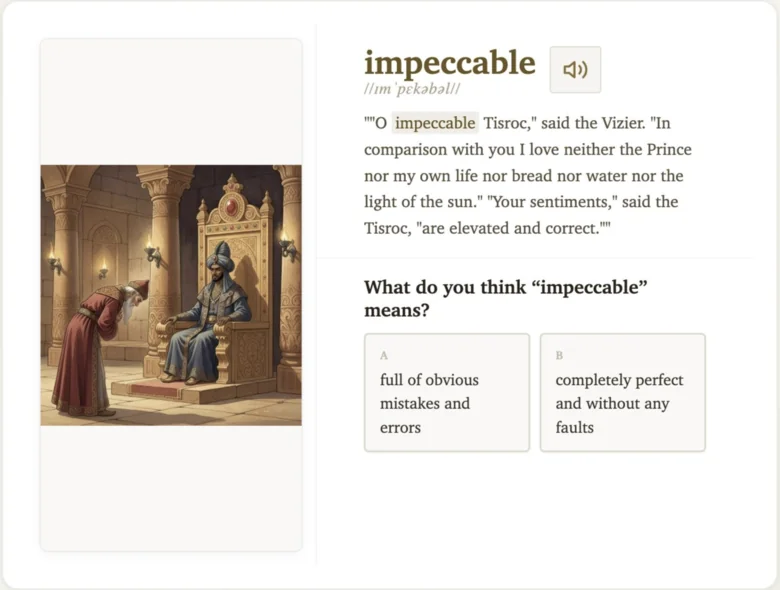
One vocabulary card, under thirty seconds. Image, audio pronunciation, a sentence pulled from the chapter, four choices. Difficulty adjusts automatically.
A real exercise from a real chapter. Image generated per word, audio is real-speaker pronunciation, sentence lifted straight from the book your kid uploaded.
Why most vocabulary apps fail
Most vocabulary apps run on a fixed schedule: roughly ten words a week, your kid takes a quiz on Friday, and those words never come back. The research on what happens next is unambiguous — about 80% of new vocabulary is gone within a week. That number has been replicated for over a century.
The proven alternative is spaced repetition. But the existing tools — Anki and its descendants — were largely designed for adults. They ask the learner to rate their own confidence ("Easy / Hard / Again"), tolerate steady failure while the algorithm calibrates, and read text-heavy cards. Most kids can't do any of those reliably. Evidence Based Vocabulary is spaced repetition rebuilt for the way kids actually learn.
How Evidence Based Vocabulary works differently
The deck builds itself — from your kid's books
Upload the EPUB they're reading — Hobbit, Narnia, Wings of Fire, whatever. Evidence Based Vocabulary extracts the words they're likely to stumble on and builds the review deck from there. No artificial weekly lists, no manual card creation.
The algorithm decides — not your kid
No "Easy / Hard / Again" buttons. Every word's challenge stays in the 70–85% accuracy zone where retention is highest. Spelling difficulty progressively hides letters as the word is mastered; meaning difficulty graduates from same-context recognition to novel sentences to multi-sense discrimination. Both directions adapt automatically — your kid never self-assesses.
Built to play, not to read
Every card has an image, an audio pronunciation, and IPA phonetics — seconds each, no walls of text. A short cooldown between cards prevents ghost-taps, and a calming break appears if your kid hits two wrongs in a row.
Built to bring your kid back tomorrow
Make your kid want to come back tomorrow and learn a few more words from their book.
Everything in Evidence Based Vocabulary — the spaced repetition, the morpheme work, the difficulty smoothing, the seconds-each cards — is a closed loop in service of that one thing.
Your kid reads a book.
Evidence Based Vocabulary extracts the words they're stumbling on.
Teaches each one through scaffolded discovery — the kid guesses, the app confirms (the generation effect: words a kid figured out themselves stick harder than words they were told).
Brings each word back right before they'd forget it (spaced repetition, SM-2).
Layers in morpheme work so future unfamiliar words decode themselves.
Ends the session before fatigue — the peak-end rule says they remember it as fun.
Tomorrow, they come back.
Loop.
A few more views from inside the app
The home screen. One tap to start the day's session — a small enough commitment that kids actually come back tomorrow.Morpheme discovery. Kids meet a prefix through illustrated word pairs, then immediately practice it. Future words containing the same morpheme pick up an annotation: "You know un- means 'not'…"Behind the scenes. We tune the algorithm to keep first-try accuracy in the 80–90% sweet spot — not for mastery, for emotional smoothness. A kid who's getting answers right comes back tomorrow.
Why we built this
Our daughter read at a 4th-grade level by kindergarten. She'd already finished all of Harry Potter and most of Roald Dahl; she was deep into Narnia and had just polished off The Hobbit.
But we noticed something the research already says out loud: she'd skip past unknown words, or guess from context and quietly internalize the wrong meaning. Reading volume alone wasn't building deep word knowledge — and the vocabulary apps we tried were the same rigid ten-words-a-week treadmill we'd hit as kids ourselves.
So we built Evidence Based Vocabulary. It teaches her the words she's actually encountering, on a schedule the science of memory has been recommending for a hundred years. She retains far more from it than she ever did from the weekly-list apps we tried before — though that's a single-family observation until our beta data lands.
Built by a software engineer with 10+ years on ML systems at autonomous-vehicle and AI companies. Long-time Anki user. Building this in evenings and weekends, anonymously, for our own kid.
Built on the science of vocabulary
Every design decision in Evidence Based Vocabulary maps to a named research tradition. Not "AI-powered" or "research-backed" hand-waving — specific findings, applied directly.
$19.99 per month, per student, with a 14-day free trial. No credit card required to start. Cancel anytime — and your kid keeps using the app through the end of the period you've paid for.
Frequently asked
When are you launching?
Today. Sign up takes 30 seconds and your kid can start their first lesson within minutes.
What does it cost?
$19.99/month per student, with a 14-day free trial. No credit card required to start. Cancel anytime, and your kid keeps using the app through the end of the period you've paid for.
What ages is it for?
Designed for independent readers — roughly ages 6 to 14. The adaptive difficulty means it works for a strong reader at age 6 and a struggling reader at age 14 alike. Younger kids who aren't reading independently yet won't get much from it.
What devices does it run on?
Any modern web browser — phone, tablet, or laptop. No app to install. Optimized for tablets, where most kids prefer it.
What happens during the free trial?
Your kid plays through 'The Wind in the Willows' for 14 days — full vocabulary lessons, illustrations, the whole experience. We don't ask for a credit card up front; you only pay if you decide to keep going. Subscribe to upload your own books and unlock the full library.
How do you handle my kid's data?
The same way we handle our own daughter's: stored only in the account you control, never sold, never shared, never used to train third-party models. Full data export and deletion on request. See our privacy policy for details.
Why books they're already reading, instead of curated word lists?
Two reasons. First, kids retain words far better when those words appear in something they care about — a Hobbit chapter beats an SAT list. Second, the research on Tier-2 vocabulary (Beck, McKeown, Kucan) finds that the highest-leverage words are the ones a child has just almost understood from context but not quite — exactly the ones their book hands you for free.
Is this just Anki for kids?
Spiritually yes — we're long-time Anki users ourselves. Practically no, in three specific ways. First, the deck builds itself from the EPUB your kid is reading; no manual card creation. Second, two adaptive tier systems run alongside SM-2 — a spelling tier that progressively masks letters as the word is mastered, and a usage tier that adds re-encounters in new contexts, novel-usage judgments, and sense-extension cards for words with multiple meanings. Third, morpheme work and image/audio/IPA come built in — in Anki you'd build all of that yourself.
Who's building this?
Software engineer, 10+ years building ML systems at autonomous-vehicle and AI companies. Long-time Anki user. Built for our own daughter — who uses Evidence Based Vocabulary every day, as our future kids will. We dogfood what we ship.